Uterine Angiolipoleiomyoma in a Premenopausal Woman: Clinical Development, Pathohistologic Findings, and Treatment - Case Report

Article Sidebar

Abstract
Introduction
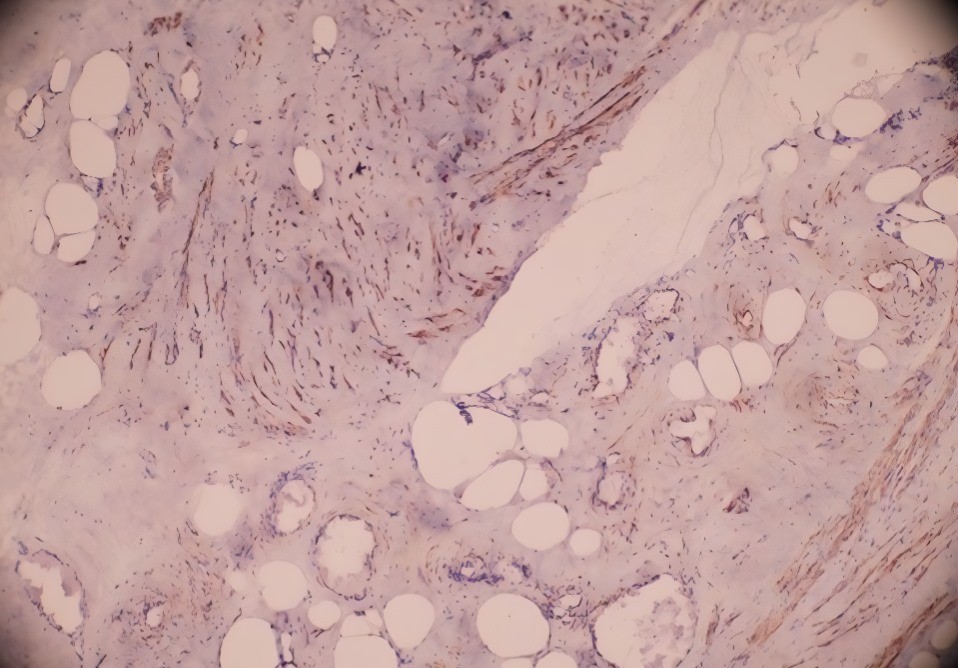
Angiolipoleiomyomas (ALLMs) are benign overgrowths of smooth muscle, adipose tissue and blood vessels. These neoplasm belong to a particular group of tumors known as mesenchymal tumors whose growth can occur in any anatomical site. ALLMs usually occur in the kidneys, but are rare in other organs such as the uterus.
Case report
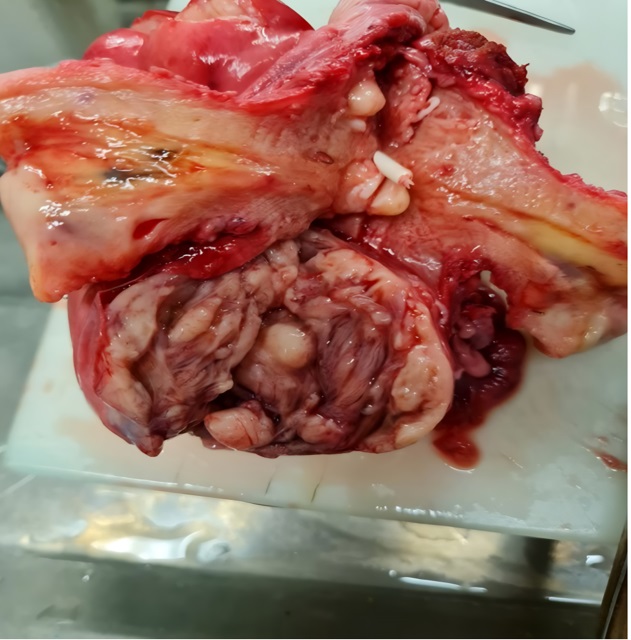
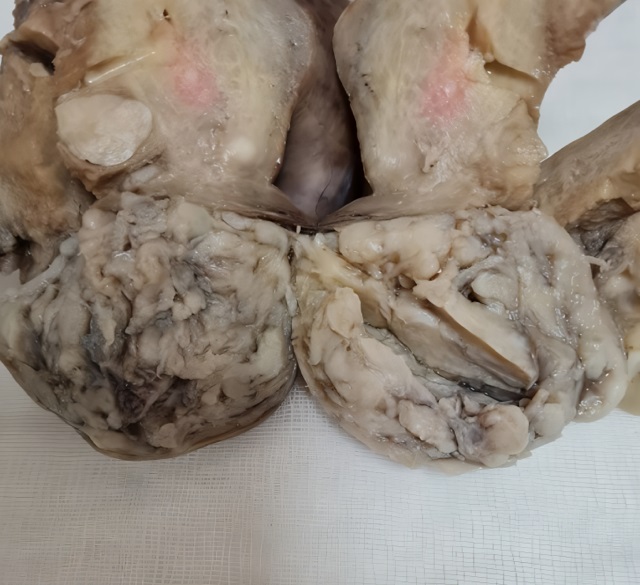
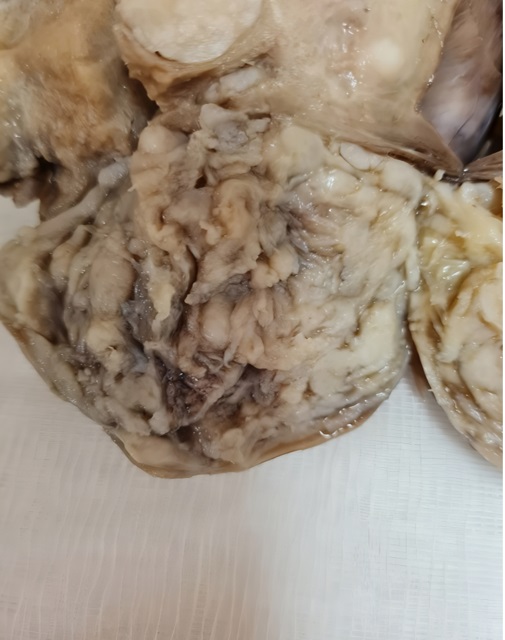
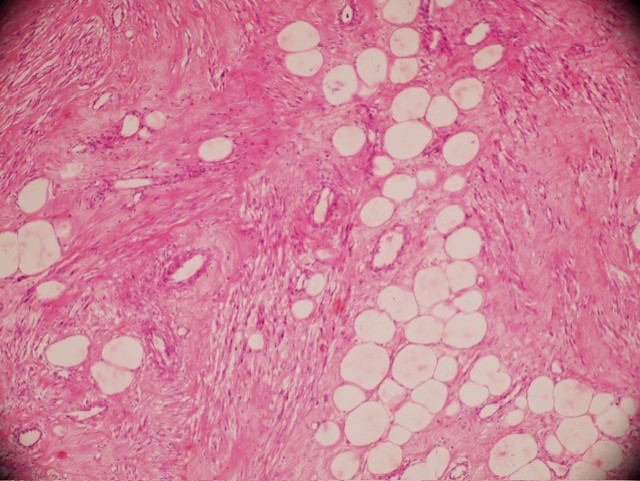
A 45-year-old woman with 3 previous deliveries presented with abnormal uterine bleeding. She was being followed for hypertension. Initial ultrasonography revealed two fibroids in the uterus. She was implanted with a levonorgestrel-containing intrauterine device (RIA). She missed follow-up appointments due to the pandemic and her complaints increased. At her second presentation, ultrasonography showed an intramural fibroid measuring 50x20 mm and several subserosal fibroids. Total abdominal hysterectomy and bilateral salpingo-oophorectomy were planned. The postoperative pathology specimen contained a 7 cm diameter angiolipoleiomyoma and an additional 4 leiomyomas.
Conclusion
Uterine ALLM is a rare benign tumor. Definitive diagnosis is made by histopathologic examination. Surgical intervention takes care of the issue at a higher efficiency level, but patients should be followed up for a long-term.
Keywords: Angiolipoleiomyoma, uterine tumor, fibroid, hysterectomy.

Full text article
References
Totev, T. P., Mateva, S. A., Nikolova, M. R., & Gorchev, G. A. (2014). Uterine angiomyolipoma: a case report, differential diagnosis with PECOMA and review of literature. Journal of Biomedical and Clinical Research, 7, 47–52.
https://doi.org/10.1515/jbcr-2015-0125
Kim HJ, Chung CM, Park JY, Jung SG. Angiomyolipoma of the Glabellar Region. Arch Craniofac Surg. 2017;18(3):202-206. doi:10.7181/acfs.2017.18.3.202
Brandfass RT, Everts-Suarez EA. Lipomatous tumors of the uterus. Am J Obstet Gynecol. 1955; 70:359-367. doi:10.1016/s0002-9378(16)37680-3.
Willén R, Gad A, Willén H. Lipomatous lesions of the uterus. Virchows Arch A Pathol Anat Histol. 1978; 377:351-361. doi:10.1007/BF00507135.
erez-Lopez FR, Ornat L, Ceausu I, et al. EMAS position statement: management of uterine fibroids. Maturitas. 2014;79:106-116. doi:10.1016/j.maturitas.2014.06.002.
Kurman RJ, Carcangiu ML, Herrington CS, Young RH. WHO Classification of Tumours of Female Reproductive Organs. IARC Press; 2014.
Oi Y, Katayama K, Hirata G, et al. Significance of postmenopausal uterine leiomyomas: focus on variants. J Obstet Gynaecol Res. 2018;44:1445-1450. doi:10.1111/jog.13675.
Henske E, Jóźwiak S, Kingswood J, Sampson J, Thiele E. Tuberous sclerosis complex. Nat Rev Dis Prim. 2016;2:16035. doi:10.1038/nrdp.2016.35.
Giannella L, Delli Carpini G, Montik N, et al. Ultrasound features of a uterine perivascular epithelioid cell tumor (PEComa): case report and literature review. Diagnostics. 2020;10(8):553. doi:10.3390/diagnostics10080553.
Nguyen J, Ghandehari H, Parra-Herran C, Vicus D. Uterine rupture: an unusual presentation of a uterine perivascular epithelioid cell tumor (PEComa). Int J Gynecol Cancer. 2020.
doi:10.1136/ijgc-2020-001837.
Tang Z, Yu D, Ni T, et al. Quantitative analysis of multiphase contrast-enhanced CT images: a pilot study of preoperative prediction of fat-poor angiomyolipoma and renal cell carcinoma. AJR Am J Roentgenol. 2019;1-13. doi:10.2214/ajr.19.21625.
Braun H, Wheelock J, Amaker B, Seeds J. Sonographic evaluation of a uterine angiolipoleiomyoma. J Clin Ultrasound. 2002;30(4):241-244. doi:10.1002/jcu.10057.
Conlon N, Soslow R, Murali R. Perivascular epithelioid tumours (PEComas) of the gynaecological tract. J Clin Pathol. 2015;68(6):418-426. doi:10.1136/jclinpath-2015-202945.
Kawauchi S, Nawata H, Yamagata Y, et al. Chromosomal imbalances detected by comparative genomic hybridization provide evidence that HMB-45-negative uterine angiomyolipomas belong to the PEComa family. Histopathology. 2010;56(7):974-977.
doi:10.1111/j.1365-2559.2010.03567.x.
Yaegashi H, Moriya T, Soeda S, et al. Uterine angiomyolipoma: case report and review of the literature. Pathol Int. 2001;51(11):896-901.
doi:10.1046/j.1440-1827.2001.01289.x.
Vidal-Mazo C, et al. Clinical recurrence of submucosal myoma after a mechanical hysteroscopic myomectomy: Review after 5 years follow up. Eur J Obstet Gynecol Reprod Biol. 2019; 243:41-45.
doi: 10.1016/j.ejogrb.2019.10.014.
Seo G, et al. Uterine angiolipoleiomyoma with US, CT, and MRI findings: A case report. Curr Med Imaging. 2022. doi:10.2174/1573405618666220321123749.
Wang J, et al. Uterine angiomyolipoma: a clinical analysis of 8 cases and literature review. Arch Gynecol Obstet. 2021; 304:171-177.
doi:10.1007/s00404-021-05992-1.
Garg N, et al. Angiolipoleiomyoma or HMB-45 negative angiomyolipoma of uterus: need for uniformity in terminology. Indian J Surg Oncol. 2021;12:239-240. doi:10.1007/s13193-021-01322-8.
Sanfilippo R, et al. Role of chemotherapy, VEGFR inhibitors, and mTOR inhibitors in advanced perivascular epithelioid cell tumors (PEComas). Clin Cancer Res. 2019;25:5295-5300.
doi:10.1158/1078-0432.CCR-19-0288.
Authors
Copyright (c) 2024 Journal of Current Medical Research and Opinion

This work is licensed under a Creative Commons Attribution 4.0 International License.