The FTIR Technique Analyzed, Antioxidant [Hypochlorous Acid Scavenging and Hydroxyl Radical Scavenging] Activity of Black pepper (Capsicum annuum L.) Extract with Metabolite Identification

Article Sidebar
-
Hypochlorous Acid Scavenging, Hydroxyl Radical Scavenging, Capsicum annuum L, Metabolite, FTIR Technique
Abstract
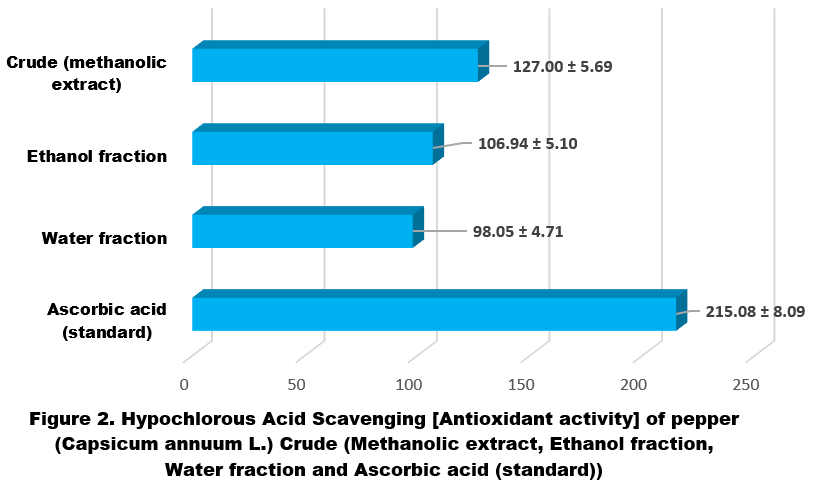
Capsicum annuum L. or peppers are an important farm crop because the plant is both a vegetable and a spice. The peppers belong to the Solanaceae family. Raw peppers contain phenolic chemicals that are very effective antioxidants and which are involved in a number of defence mechanisms by plants, including vitamins A and C, acidic and neutral ones. Several species and varieties of the genus Capsicum owe their typically spicy smell to the presence of the capsaicinoids, capsaicin and dihydrocapsaicin. Peak (Wave number cm-ˡ), Functional group assignment, Type of Vibration, Bond, Area, Corr. Area and Intensity (667.37, alkyl halides, Stretch, C-Cl, 0.064, and 2.947), (873.75, Alkenes, Bending, =C–H, 0.161, and 2.864), (921.97, Alkenes, Bending, =C–H, 0.006v, and 2.459), (1026.13, alkyl halides, Stretch, C-F, 14.196, and 40.600), (1139.93, alkyl halides, Stretch, C-F, 0.381v, and 6.633), (1234.44, alkyl halides, Stretch, C-F, 0.015, and 2.346), (1317.38, alkyl halides, Stretch, C-F, 0.116, and 3.234), (1379.10, alkyl halides, Stretch, C-F, 0.026, and 3.677), (1415.75, Aromatic, Stretch, C=C, 0.223, and 4.948), (1519.91, Aromatic, Stretch, C=C, 0.065, and 2.191), (1598.99, Aromatic, Stretch, C=C, 0.085, and 3.642), (1740.72, Aldehyde, Stretch, C=O, 0.743 and 2.000), (2852.72, Alkane, Stretch, C-H, 0.244, and 2.649), (2922.16, Alkane, Stretch, C-H, 0.893, and 4.668), (3223.05, Amide, Stretch, N-H, 0.016, and 1.955), (3265.49, Amide, Stretch, N-H, 0.010, and 1.934). Hypochlorous Acid Scavenging Hydroxyl Radical Scavenging [Antioxidant activity] of pepper (Capsicum annuum L.) Crude (Methanolic extract, Ethanol fraction, Water fraction and Ascorbic acid (standard)) recorded (127.00 ± 5.69, 106.94 ± 5.10, 98.05 ± 4.71, and 215.08 ± 8.09 respectively) while recorded (167.05 ± 6.00, 180.93 ± 6.09, 200.45 ± 6.87, and 514.16 ± 18.01 respectively)
Full text article
References
Hamed M, Kalita D, Bartolo ME, Jayanty SS (2019). Capsaicinoids, polyphenols and antioxidant activities of Capsicum annuum: comparative study of the effect of ripening stage and cooking methods. Antioxidants 8: 364.
Cisternas-Jamet J, Salvatierra-Martínez R, Vega-Gálvez A, Stoll A, Uribe E, Goñi MG (2020) Biochemical composition as a function of fruit maturity stage of bell pepper (Capsicum annum) inoculated with Bacillus amyloliquefaciens. Sci Horticult 263: 109107.
Ribes‐Moya AM, Adalid AM, Raigón MD, Hellín P, Fita A, Rodríguez‐Burruezo A (2020). Variation in flavonoids in a collection of peppers (Capsicum sp.) under organic and conventional cultivation: effect of the genotype, ripening stage, and growing system. J Sci Food Agric 100: 2208–2223.
Martí MC, Camejo D, Olmos E, Sandalio LM, Fernández-García N, Jiménez A, Sevilla F (2009) Characterisation and changes in the antioxidant system of chloroplasts and chromoplasts isolated from green and mature pepper fruits. Plant Biology 11: 613–624.
Mateos RM, Bonilla-Valverde D, del Río LA, Palma JM, Corpas FJ (2009) NADP-dehydrogenases from pepper fruits: Effect of maturation. Physiol Plant 135: 130–139.
Ramírez-Serrano R, Larrinaga-Mayoral JA, Murillo-Amador B, Hernández-Saavedra NY, Fujiyama H (2008) ntioxidant enzymatic response of hot pepper (Capsicum annuum L.) under saline stress conditions. Interciencia 33: 377-383.
Boonsiri K, Ketsa S, van Doorn WG (2007) Seed browning of hot peppers during low temperature storage. Postharv Biol Technol 45: 358-365.
Tan CK, Ali,ZM, Zainal Z (2012) Changes in ethylene production, carbohydrase activity and antioxidant status in pepper fruits during ripening. Sci Horticult 142: 23-31.
Airaki M, Sánchez-Moreno L, Leterrier M, Barroso JB, Palma JM, Corpas FJ (2011) Detection and quantification of S-nitrosoglutathione (GSNO) in pepper (Capsicum annuum L.) plant organs by LC-ES/MS. Plant Cell Physiol 52: 2006-2015.
Shaimaa, G.A.; Mahmoud, M.S.; Mohamed, M.R.; Emam, A.A. Effect of Heat Treatment on Phenolic and Flavonoid Compounds and Antioxidant Activities of Some Egyptian Sweet and Chilli Pepper. Nat. Prod. Chem Res. 2016, 4, 218. [Google Scholar] [CrossRef]
Turkmen, N.; Sari, F.; Velioglu, Y.S. The effect of cooking methods on total phenolics and antioxidant activity of selected green vegetables. Food Chem. 2005, 93, 713–718.
Belwal, T.; Pandey, A.; Bhat, I.D.; Rawal, R.S.; Luo, Z. Trends of polyphenolics and anthocyanins accumulation along ripening stages of wild edible fruits of Indian Himalayan region. Sci. Rep. 2019, 9, 5894.
Aruoma OI, Halliwell B, Hoey BM, Butler J: The antioxidant action of N-acetylcysteine: Its reaction with hydrogen peroxide, hydroxyl radical, superoxide, and hypochlorous acid. Free Rad Biol Med. 1989, 6: 593-597.
Pedraza-Chaverrí J, Arriaga-Noblecía G, Medina-Campos ON: Hypochlorous acid scavenging capacity of garlic. Phytother Res. 2007, 21: 884-888.
Arnnok, P.; Ruangviriyachai, C.; Mhachai, R.; Techawongstien, S.; Chanthai, S. Determination of total phenolics and anthocyanin contents in the pericarp of hot chilli pepper (Capsicum annuum L.). Int. Food Res. J. 2011, 19, 235–243. [Google Scholar]
Khoo, H.E.; Azlan, A.; Tang, S.T.; Lim, S.M. Anthocyanidins and anthocyanins: Colored pigments as food, pharmaceutical ingredients, and the potential health benefits. Food Nutr. Res. 2017, 61, 1361779.
Sora, G.T.S.; Haminiuk, C.W.I.; Vieira da Silva, M.; Zielinski, A.A.F.; Gonçalves, G.A.; Adelar Bracht, A.; Peralta, R.M. A comparative study of the capsaicinoid and phenolic contents and in vitro antioxidant activities of the peppers of the genus Capsicum: An application of chemometrics. J. Food Sci. Technol. 2015, 2, 8086–8094.
Gómez-García Mdel, R.; Ochoa-Alejo, N. Biochemistry and molecular biology of carotenoid biosynthesis in chili peppers (Capsicum spp.). Int. J. Mol. Sci. 2013, 14, 19025–19053.
Srinivasan, K.; Sambaiah, K.; Chandrasekhara, N. Loss of active principles of common spices during domestic cooking. Food Chem. 1992, 43, 271–274.
Authors
Copyright (c) 2025 https://creativecommons.org/licenses/by/4.0/

This work is licensed under a Creative Commons Attribution 4.0 International License.